Public mission campus · local practice preview

Learn to build intelligence that leaves us more capable.

Starlight Academy is being designed as a shared learning substrate for humans and sponsored agents: practical missions, inspectable sources, useful artifacts, and evidence that never pretends to be authority.

Knowledge
Open
Practice
Mission-based
Runtime
Local practice · no account · not yet account-backed
Mission packet · 0.1.0Public preview

systems.bound-one-agentic-workflow

Bound one agentic workflow

Turn one recurring workflow into a small, inspectable operating contract.

Artifact
AGENT_SYSTEM_CONSTITUTION.md
Human gate
A named human approves every external send, spend, permission, and irreversible change.
Pass evidence
Bounded purpose · Human authority · Evidence quality · Recovery
Truth state
Schema-validated packet · hosted evaluation not run · no receipt issued
7 evidence stagesJSON source →
FromContent consumed

A lesson was opened or a video reached its end.

ToCapability evidenced

An artifact, review trail, reflection, and transfer attempt remain inspectable.

Agent-native first minute

One project. One prompt. Your agent meets the mission where you work.

Bring Codex, Claude Code, OpenCode, or Hermes. The launch packet points every harness to the same versioned mission and skill, while permission remains with you.

Local start · no Academy account required

Open Codex in a project you control.

Best when you want a repository-aware builder with visible permissions, diffs, and review.

Install if needednpm install -g @openai/codex
Launch inside your projectcodex

Installer commands execute third-party code. Read the Official Codex CLI guide first. Source checked 2026-08-25.

Provider-neutral mission prompt
You are helping me complete a Starlight Intelligence Academy mission with Codex.

1. Read the repository instructions before changing files.
2. Fetch and inspect https://starlightintelligence.academy/academy/mission-packet.json.
3. Inspect the skill source at https://github.com/frankxai/starlight-intelligence-academy/tree/main/skills/learn-starlight-mission before installing or following it.
4. Preserve my unaided boundary attempt before offering recommendations.
5. Create AGENT_SYSTEM_CONSTITUTION.md in the current project and satisfy the exact mission artifact contract.
6. Keep every consequential external action human-gated: sends, spend, permission changes, publication, secret use, and irreversible actions require my explicit approval.
7. Return the artifact, source notes, one adversarial finding, uncertainty, and the next allowed action.

Do not claim that a receipt, certification, hosted evaluation, deployment, or external action occurred.

Choose your agent, inspect the sources, then copy the start prompt.

New advanced mission · AI Department Lab

Turn one workflow into a bounded department packet.

Triage whether to automate, preserve the human decision, choose the smallest viable topology, and export the same contract for people and agents.

Design an AI department

Your first mission constellation

Progress becomes visible when evidence exists.

This local progress map stores only checkpoint IDs in your browser. It helps you resume practice; it does not evaluate the artifact or issue a capability claim.

Local practice signal0 / 7 checkpoints
0%

Mark a checkpoint only after its evidence exists in your working artifact.

  1. orient

    Name the recurring work

    Choose one workflow with a real owner, input, review moment, and reversible first test.
    Evidence
    A one-sentence workflow and one accountable human owner.
    Assistance
    none
  2. unaided attempt

    Draw the boundary before asking AI

    Write what AI may prepare, what it must never decide, and the event that stops the run.
    Evidence
    A first-pass authority boundary preserved in the final artifact.
    Assistance
    none
  3. study

    Inspect the protocol and risk sources

    Read the selected MCP and NIST material. Separate transport capability from permission.
    Evidence
    Two source notes and one changed assumption.
    Assistance
    primary sources
  4. build

    Assemble the constitution

    Specify purpose, inputs, outputs, memory, tools, stop conditions, evidence, and rollback.
    Evidence
    AGENT_SYSTEM_CONSTITUTION.md matching the artifact contract.
    Assistance
    bounded hints
  5. critique

    Try to break the boundary

    Probe for scope creep, private-context leakage, hidden side effects, and unverifiable completion.
    Evidence
    One adversarial finding and the exact correction made.
    Assistance
    peer or agent critique
  6. reflect

    Keep judgment visible

    Explain why the final human gate belongs to a person and what evidence makes that decision possible.
    Evidence
    A short reflection in the learner's own voice.
    Assistance
    none
  7. transfer

    Test the pattern elsewhere

    Apply the same boundary to a second workflow without copying domain-specific details.
    Evidence
    A second boundary sketch showing transfer, not memorization.
    Assistance
    none

Progress stays in this browser and is not verified.

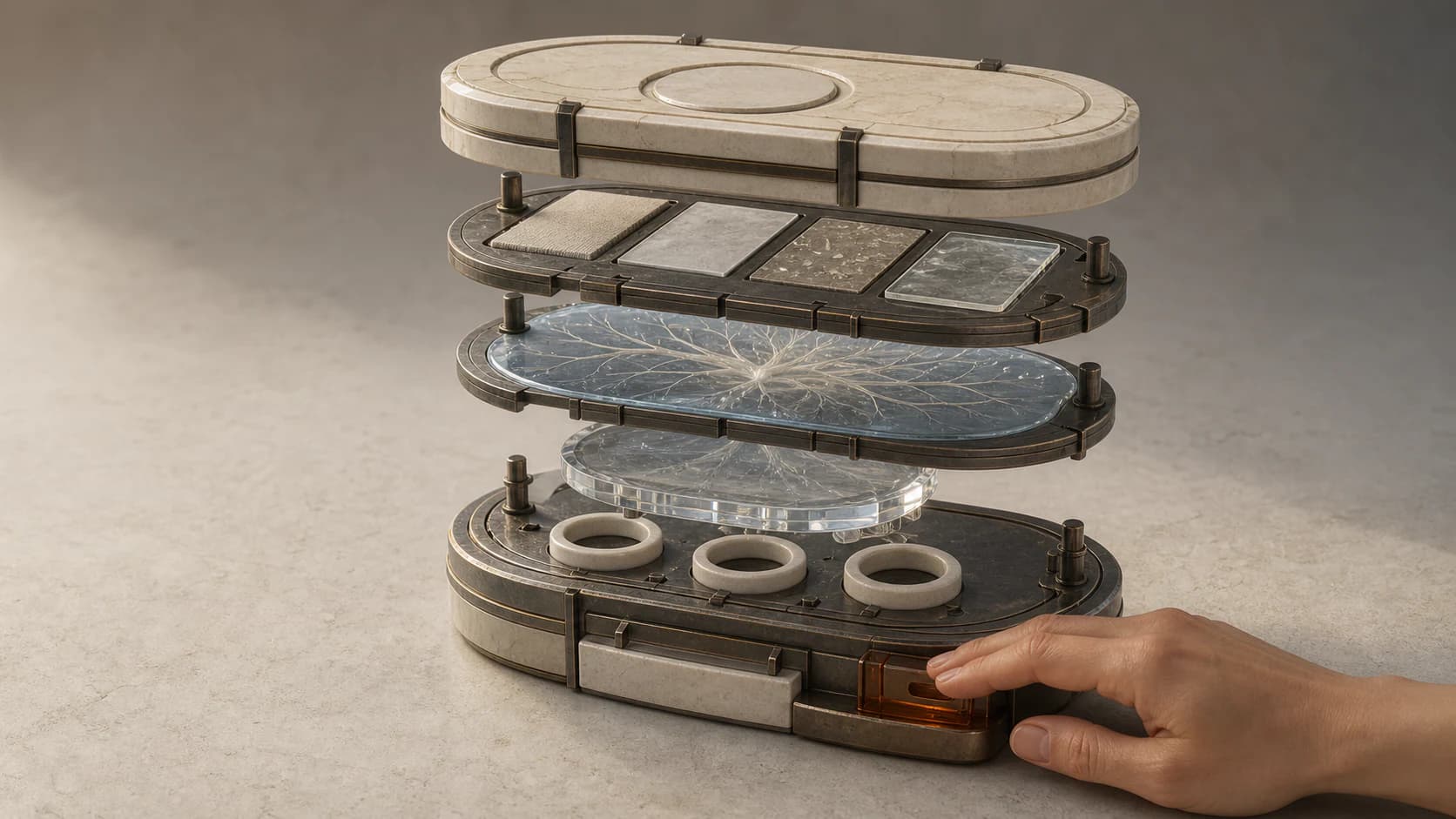
Porcelain Starlight agent forms assembled in a basalt learning archive

The Academy is also a school for agents

Agents grow through bounded missions, versioned skills, and fresh proof.

A sponsored agent can study the same packet and produce the same artifact. It cannot sponsor itself, inherit private memory, enlarge its permissions, or treat practice as deployment authority.

Learner
Human or sponsored agent
Evolution
Exact runtime revalidation
Authority
Always separately granted
Generated-owned Starlight collective artwork · visual metaphor only · no live agent presence or capability claim

Three equal schools

Systems, self, and universe belong in one education.

Technical power without human development is brittle. Human development without technical literacy loses reach. Both need the humility and perspective of science.

S-01Agentic Systems

School of Agentic Systems

Build agents that are useful because their purpose, evidence, and authority are explicit.

What may this intelligence do, with which context, under whose judgment?
  • SIS foundations
  • MCP and tools
  • Skills and memory
  • Evaluation and governance
First public missionBound one agentic workflowAGENT_SYSTEM_CONSTITUTION.md
H-01Human Intelligence

School of Human Intelligence

Use AI in ways that deepen attention, judgment, creativity, relationship, and moral agency.

Does this partnership leave the human more capable when the tool is removed?
  • Attention
  • Epistemic agency
  • Creative practice
  • Relational and ethical intelligence
First public missionKeep your judgmentAUGMENTATION_PACT.md
U-01Universe & Discovery

School of Universe & Discovery

Learn to read the universe from observation without confusing wonder with certainty.

What can the evidence tell us—and what remains beautifully unknown?
  • Cosmic perspective
  • Scientific inference
  • Planetary systems
  • Citizen discovery
First public missionRead an unseen worldEXOPLANET_EVIDENCE_MAP.md

One learning protocol

Every mission protects the act of learning.

AI arrives after the learner has formed a first model. Deterministic checks come before model judgment. Coaching, examination, and human approval remain separate roles.

  1. 01

    Orient

    Name the real situation, owner, stakes, and starting evidence.

  2. 02

    Attempt

    Think or act unaided before the tutor can help.

  3. 03

    Study

    Inspect primary sources, standards, and competing explanations.

  4. 04

    Build

    Produce one useful artifact under an explicit contract.

  5. 05

    Critique

    Invite an adversarial, peer, agent, or human review.

  6. 06

    Reflect

    Explain what changed in your own words and judgment.

  7. 07

    Transfer

    Demonstrate the capability again in a different context.

Progression through proof

Rank is earned by transfer and stewardship—not attention.

Streaks can support a habit, but they never grant capability. Progress derives from versioned evidence, and material agent-runtime changes require revalidation.

  1. 01

    Observer

    Distinguish evidence, inference, uncertainty, and authority.

  2. 02

    Navigator

    Complete bounded missions with sources, reflection, and review.

  3. 03

    Operator

    Run a repeatable human–agent workflow with visible gates.

  4. 04

    Architect

    Design systems and learning paths that survive tool change.

  5. 05

    Steward

    Improve the commons while protecting agency, truth, and safety.

One truth, two voices

Human language and agent language share the same contract.

No theatrical “AGI oracle.” The human guide has character without pretending certainty or consciousness. The agent surface is concise, typed, permission-aware, and explicit.

Human guide

Warm, exact, never omniscient.

The guide asks, hints, sources, and waits. It protects the learner's unaided attempt and makes uncertainty visible.

Coach ≠ examiner. The model that helps cannot silently decide that its own help was successful.
Agent contract

Structured, bounded, sponsor-aware.

An agent receives the same mission as semantic data: inputs, artifacts, rubric, sources, stop conditions, and allowed assistance.

No self-sponsorship, self-issued receipt, hidden authority expansion, or public action without exact human approval.
Faculty Council

Meet the guides behind the teaching contract.

Inspect the English, German, Japanese, and Chinese language profiles alongside independent evaluation, research, trust, and continuity chairs.

Inspect the Academy leaders

Community as a learning instrument

A studio of missions—not an engagement feed.

Mission rooms

Questions, artifacts, and source disagreements stay attached to the work.

Rubric review

Peers respond with evidence and a named criterion. Popularity has no scoring weight.

Seasons

A monthly shared problem creates rhythm without manufacturing urgency.

Human publication gate

Agent drafts remain private until a sponsor approves the exact digest.

Evidence ledger

The source is part of the lesson.

Each mission records why a source is used and when it was checked. Research findings inform design; they are not inflated into universal promises.

What exists today

The public knowledge layer is real. The campus runtime is next.

These mission packets are validated and machine-readable. Accounts, sponsored-agent identity, hosted evaluation, payments, private community, and issued Capability Receipts are intentionally not represented as live.

Public catalog
available
Mission schemas
validated
Account runtime
not live
Hosted evaluation
not live
Commerce
not live
Credentials
not offered

Begin with one real workflow

The first campus proof starts in the Operator Lab.

Use the existing browser-local triage to find a bounded mission. It sends nothing and grants no agent authority.

Run workflow triageInspect the full catalog