Begin with someone whose day could improve
Choose a person, community or living system affected by your invention. Describe a moment in their day before describing the machine. A learner needs a patient explanation; a maintenance crew needs access; an animal needs a viable habitat. A giant intelligence becomes meaningful through the relationship it supports.
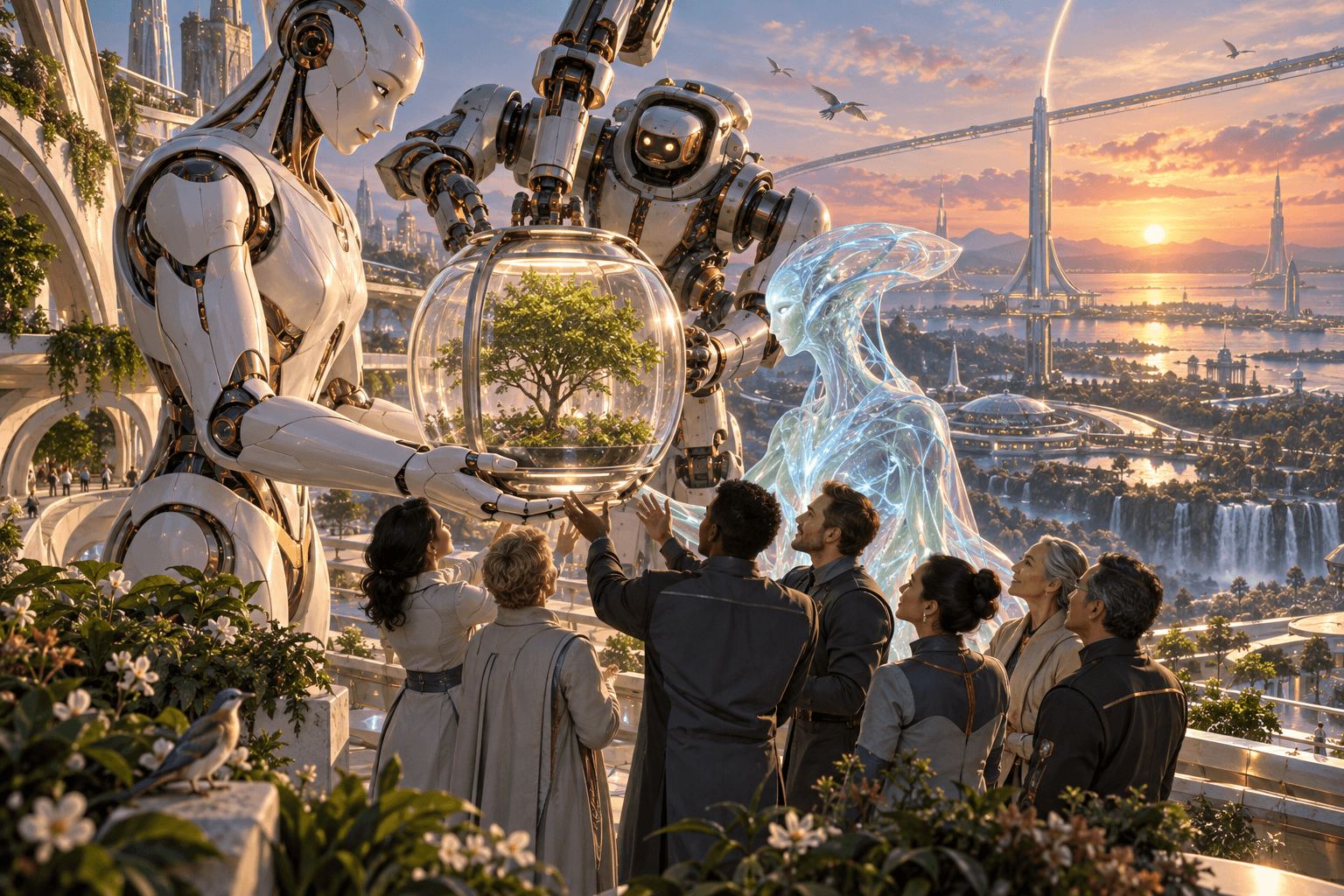
The Academy's visual motif is a small act of care echoed by a monumental structure. In the nursery scene, a seedling handoff connects attention at human scale to civilization-scale capability. The image is a question about values, not proof that such a system exists.
Give the beautiful object a working life
Write how people enter, use, maintain, repair and eventually retire the object. Show joints, supports, access paths and where materials travel. Ask what happens during a power interruption or an ambiguous instruction. Design becomes more interesting when its everyday use is as considered as its silhouette.
Use contrast deliberately: one focal action, a clear middle distance and a larger world. Keep interfaces legible and movement purposeful. In a learning experience, motion should reveal a relationship or change in state. A spectacular transition that interrupts reading has failed the learner's task.
Keep the claim boundary inside the creative process
Label what is established, what is an engineering proposal and what is speculative worldbuilding. A glowing brain, a thriving forest and a smiling researcher can imply competence without demonstrating it. Write what evidence a real version would need before claiming that it benefits people or ecosystems.
Invite critique from another perspective. Ask who is absent, who maintains the system and who can decline its help. Revise one specific detail in response. This is how imagining benevolence becomes a repeatable design practice: a value, a concrete choice, a challenge and a visible revision.
A worked example · Illustrative
From value to inspectable choice
Value: learners retain agency
Scene: a giant teacher supports a small human experiment
Design choice: the learner can pause, inspect and question
Failure question: can the lesson continue without motion or AI?
Evidence for a real product: observed task completion and critique
Art label: speculative future; no endorsement or AGI claim
Put the idea to work
Your practice
- Choose a stakeholder and describe their concrete need.
- Write one scene with a small action and a meaningful large system.
- List use, maintenance, refusal and failure conditions.
- Get a skeptical critique and revise one visible detail.