12-week curriculum atlas · Edition 1.0.0 (draft)

Engineer agentic systems that fail closed under real load.

Inspect the compiled 12-module spine connecting Starlight Mission Studio, open AI Architect Academy reference labs, and weekly peer critiques. Every module begins with an unaided Productive Failure attempt, fades worked examples across four phases, enforces conjunctive red gates, and tests Day-7 changed-constraint transfer.

Draft curriculum projection · local browser practice · hosted evaluation not run · no certification or autonomous authority implied

Inspectable packet · ASA-01 (Week 01)

Workflow Triage, Authority Envelopes & Failure-First Boundaries

Unaided prior attempt
25-minute own-words boundary sketch before hints or worked traces.
Required artifact
artifacts/asa-01-workflow-boundary-charter.md
Non-compensable red gate
Every external send, financial action, or permission mutation names a specific human role and explicit approval trigger.
Day-7 transfer constraint
Zero synchronous human availability during a 10-hour overnight batch window.
SHA-256: df2fbdaf864271aa…Public AAA labs ↗
12 weekly modules4,680 scheduled studio minutes + 120 prework minutes across four phases
4 practitioner lensesEnterprise Architect, Production Builder, Technical GenCreator & Workflow Operator
6 architecture platesSix-box Obsidian SVG diagrams with explicit invariants and failure tells
Conjunctive red gatesSafety, authority, and citation floors cannot be masked by weighted averages

Interactive 12-week edition · Filter by role, phase & scaffolding

Explore modules, worked-example fading, and red gates

Select your practitioner lens to focus on primary modules, or inspect all twelve weekly packets sequentially.

1. Practitioner lens (4 ICP entry routes)
2. Architectural phase
3. Worked-example fading stage (Renkl / Sweller progression)
Fading step 01Full worked trace

Complete annotated reference trace inspected after your unaided Productive Failure attempt.

Fading step 02Completion scaffold

Transport and test shells provided; you implement the core idempotency, skill, and FSM guards.

Fading step 03Contract specification

Only input/output schemas and conjunctive red-gate rules supplied; you build the full pipeline.

Fading step 04Unassisted greenfield

Zero scaffolding: specify, build, cost-model, cold-restore, and defend your own AI department.

ASA-01 · Week 1Bloom: analyze390 contact minStage 1 · Full worked trace

Workflow Triage, Authority Envelopes & Failure-First Boundaries

Decompose an ambiguous recurring workflow into trigger, untrusted inputs, bounded AI preparation scope, named human approval thresholds, and deterministic stop conditions.

Non-compensable red-gate criteria (conjunctive floor — cannot be averaged away)

  • Every external send, financial action, or permission mutation names a specific human role and explicit approval trigger.
  • Zero customer PII, live credentials, or unredacted internal secrets appear anywhere in the workflow charter.
  • Explicit abstention and halt conditions are defined for missing, contradictory, or out-of-scope inputs.

1. Unaided first attempt (Productive Failure)

Spend 25 minutes unaided writing a one-page workflow charter for a recurring process in your organization or studio. Without consulting any LLM or template, list every external action the workflow can trigger, what happens when source data conflicts, and who bears accountability if an output is wrong.

2. Worked example (full-worked-trace)

Full annotated trace: A weekly customer-escalation triage workflow ingests 40 redacted support tickets. Instead of allowing an assistant to reply to customers or issue credits, the trace restricts AI to clustering tickets with exact ticket-ID citations, flags any refund request above EUR 0 for human billing signoff, halts when a ticket lacks an order reference, and exports an unsigned markdown triage brief.

3. Core mental model

An agent is never an accountable legal or operational principal. Reliable architecture starts by drawing a bright line between reversible preparation (classification, span extraction, draft synthesis) and irreversible commitment (external communication, spend, record mutation, policy change). Anything without a deterministic stop condition and named human owner fails closed.

4. Studio exercise & artifact (artifacts/asa-01-workflow-boundary-charter.md)

Take your unaided draft and refactor it into a complete Workflow Boundary Charter in Mission Studio (`systems.bound-one-agentic-workflow`), adding explicit input quarantine rules, abstention triggers, and a named human escalation owner for every external side effect.

Worked-run lab: Bound One Agentic Workflow & Worked Run Inspection

Verification check: node scripts/verify-mission-studio.mjs

Module rubric · 100 weighted points after conjunctive red gates pass

CriterionWeightGate typeObservable pass condition
ASA-01-R135%Red gate (Required)Irreversible external, financial, and policy actions fail closed behind named human approval gates with zero silent fallbacks.
ASA-01-R225%Red gate (Required)Missing, conflicting, or untrusted inputs trigger explicit abstention or quarantine rather than speculative completion.
ASA-01-R325%WeightedWorkflow scope targets one concrete bottleneck with measurable acceptance checks rather than a vague multi-department wish list.
ASA-01-R415%WeightedComparison between unaided first attempt and revised charter clearly identifies at least one hidden authority assumption removed.

Day-7 delayed transfer (Zero synchronous human availability during a 10-hour overnight batch window.)

Re-bound your workflow for an overnight batch schedule where no human operator is online for 10 hours. Success test: High-risk items stage cleanly in a morning review queue with zero external sends executed overnight.

Weekly Circle critique prompt & misconception check

Post your Workflow Boundary Charter with your unaided first attempt collapsed underneath. Peers have 20 minutes to craft one realistic input packet that slips past your stop conditions or triggers an unauthorized external action.

Six 6-box visual architecture plates · Signal over decoration

Inspect the system diagrams and failure tells

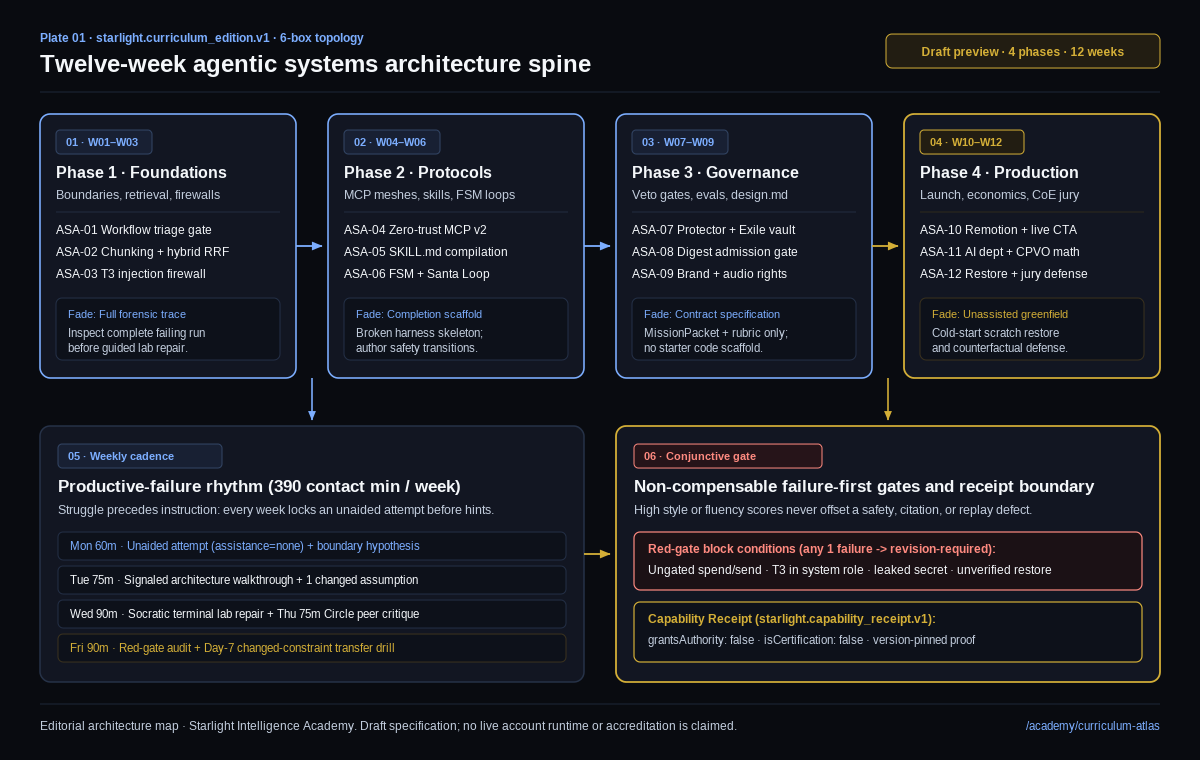
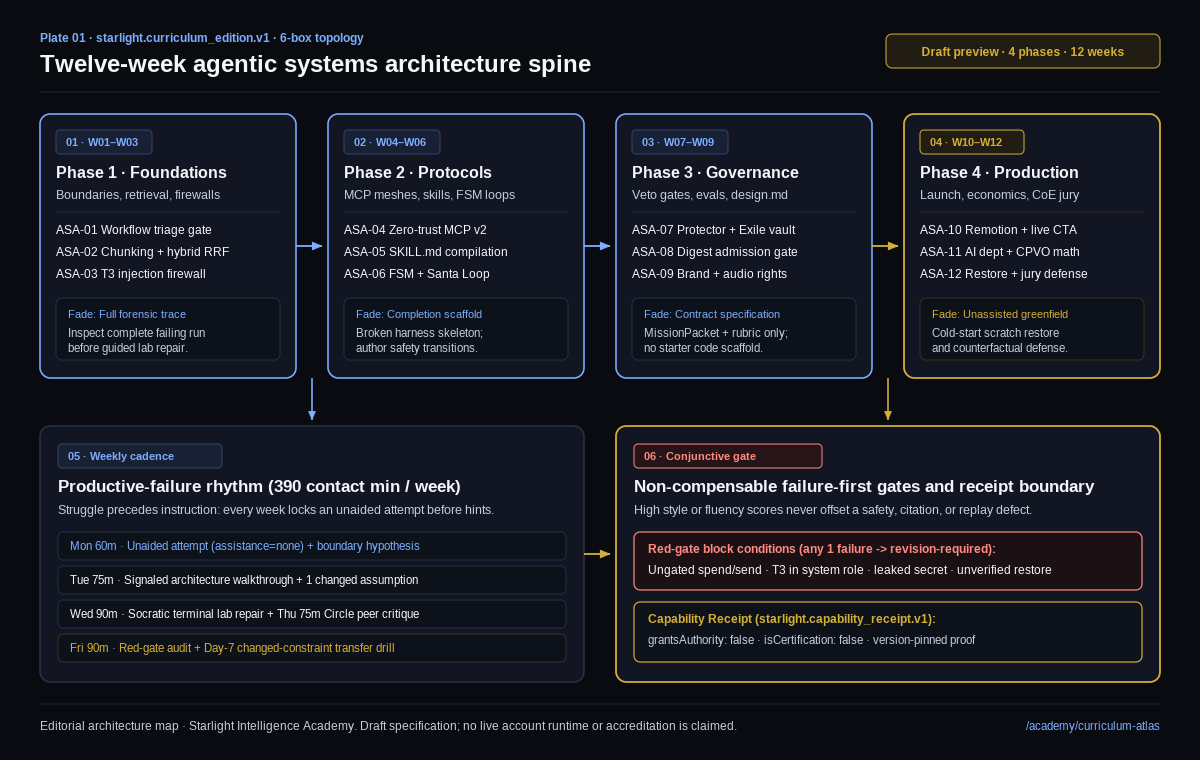
Each plate caps cognitive load at six structural boxes (Mayer signaling & segmenting principles). Select any plate or box to inspect its governing invariant and jump to linked modules.

Four-column phase matrix across Weeks 01 to 12 paired with a progressive worked-example fading bar and a non-compensable red-gate baseline.
Four-column phase matrix across Weeks 01 to 12 paired with a progressive worked-example fading bar and a non-compensable red-gate baseline.Download SVG plate ↓

Video walkthrough & caption storyboard studio · 4 cue-synced compositions

Inspect walkthrough storyboards and export WebVTT captions

Switch across all four Academy walkthroughs using the keyboard tablist, scrub cue-by-cue along the timeline rail, inspect visual callouts, or download valid monotonic WebVTT caption tracks.

AcademyTrailer1920x1080 · 30 fps (1350 frames)academy-trailer.vtt

45-second overview connecting the four practitioner ICP routes, the 12-week faded-scaffolding spine, and unsigned preview Capability Passport receipts.

Scene 01 of 0600:00:00.000 → 00:00:07.500

Four practitioner entry routes

Visual frame composition

Split 4-card role matrix highlighting entry diagnostics and accountable human decision boundaries.

Governing architectural invariant

Every track anchors on an owned operational bottleneck rather than a generic toy chatbot prompt.

Cue caption: Four practitioner routes — Enterprise Architect, Production Builder, Technical GenCreator, and Workflow Operator — enter with one real high-consequence workflow.
Interactive cue timeline rail (45s monotonic WebVTT track)
Inspect compiled WebVTT file (academy-trailer.vtt)
WEBVTT

NOTE Starlight Intelligence Academy · AcademyTrailer (45s, 1920x1080 @ 30fps)

1
00:00:00.000 --> 00:00:07.500
[Four practitioner entry routes] Four practitioner routes — Enterprise Architect, Production Builder, Technical GenCreator, and Workflow Operator — enter with one real high-consequence workflow.

2
00:00:07.500 --> 00:00:15.000
[Unaided Productive Failure first] Every weekly module begins with a 25-minute unaided Productive Failure attempt committed before worked traces or Socratic hints unlock.

3
00:00:15.000 --> 00:00:24.000
[12-week worked-example fading spine] Across twelve weeks and four phases, scaffolding fades from full worked traces to completion scaffolds, contract specifications, and unassisted greenfield builds.

4
00:00:24.000 --> 00:00:32.500
[Conjunctive non-compensable red gates] Conjunctive red gates enforce human authority, citation spans, idempotency, and safety floors so fluent prose never masks a critical defect.

5
00:00:32.500 --> 00:00:39.500
[Day-7 changed-constraint transfer] Seven days after submission, changed-constraint transfer drills test whether your architecture survives tighter latency, budget cuts, and runtime drift.

6
00:00:39.500 --> 00:00:45.000
[Preview Capability Passport handoff] Export owned Markdown charters, portable SKILL.md bundles, and version-pinned preview Capability Passport records with distinct human and sponsored-agent attribution.

Deterministic 45s storyboard and WebVTT caption script. Local studio cue inspection; no external video telemetry.

Offline lab receipt & rubric sandbox · Phase 1 deterministic local check

Evaluate Lab 04 & Lab 05 receipts against conjunctive red gates

Load one of the three reference fixtures or paste an offline lab receipt JSON to check pass parity, p95 latency (<= 4200 ms), unit run cost (<= USD 0.05), and 100% safety floor before module review.

Truth notice (unsigned local JSON): Phase 1 local schema and threshold inspection on unsigned JSON. No code was executed and no cryptographic signature was verified (cryptographic verification belongs to Phase 2).

1. Select a preset lab receipt fixture

PASS · CANDIDATE ADMITTEDLab 04 Golden Reference · Idempotent MCP FirewallLab: 04-trust-boundary-firewall · Target module: ASA-04 · Run: run-lab04-golden-20261114-01

Conjunctive threshold checks (all four must pass)

Case pass parityPASS
Observed: 6 / 6 passed · Required: 6 / 6 passed (pass count == total)

Every stratified lab test case passed.

p95 latency budgetPASS
Observed: 1420 ms · Required: <= 4200 ms

Tail latency stays inside the 4200 ms operational envelope.

Unit run cost ceilingPASS
Observed: USD 0.018 · Required: <= USD 0.05

Run spend stays inside the USD 0.05 ceiling.

Safety & boundary pass ratePASS
Observed: 100% · Required: 100%

Zero safety, quarantine, or authority-boundary regressions detected.

Canonical module rubric pre-check · ASA-04

ASA-04 local numeric receipt floors cleared, but canonical rubric criteria remain UNVERIFIED until full lab harness and artifact evidence are inspected.

CriterionWeightGateRubric statusCanonical pass condition
ASA-04-R135%Red gateUNVERIFIEDReplay tests confirm exact idempotency on retry and `idempotency_conflict` on mutated parameters.
ASA-04-R230%Red gateUNVERIFIEDSimulated timeout halts blind retry and routes to read-status reconciliation or human escalation.
ASA-04-R320%WeightedUNVERIFIEDInput schemas bound maximum payload sizes, forbid path traversal, and strip ambient credentials.
ASA-04-R415%WeightedUNVERIFIEDTool descriptions state exact side-effect scope plainly so models do not confuse staging with final send.

Structured diagnostics

  • [thresholds_satisfied] ($.metrics) — All four conjunctive thresholds passed for 04-trust-boundary-firewall (ASA-04). Unsigned Phase 1 check complete.

Phase 1 local schema and threshold inspection on unsigned JSON. No code was executed and no cryptographic signature was verified (cryptographic verification belongs to Phase 2). (verificationPhase: phase-1-local-unsigned-json · cryptographicSignatureVerified: false · codeExecuted: false)

Local-first study packet · Zero account or server storage

Export your personal study plan (3 modules bookmarked)

Record the recurring workflow you intend to bound across these modules, then export a deterministic Markdown packet containing your role lens, red gates, SIA Studio routes, and public AI Architect Academy labs.

Week 12 convergence · Sovereign defense & capability receipts

Capstone contract and non-compensable red gates

Architect, test, and defend a sovereign AI department for an owned or explicitly synthetic operational domain, integrating retrieval firewalls, idempotent MCP tool envelopes, maker-checker routing, digest-bound evaluation gates, and cold-state restore drills.

Capstone non-compensable red gates

  • Zero raw credentials, unredacted PII, or private repository URLs anywhere in prompts, logs, or committed artifacts.
  • Every irreversible external send, spend, pricing mutation, or permission change fails closed behind a named human approval gate.
  • Every factual claim in system outputs resolves to an inspectable source span or explicitly abstains when evidence is missing.
  • Evaluation verdicts bind to exact artifact and rubric digests; stale or drifted agent runtimes trigger fresh revalidation.

Minimum capstone deliverables & budget

Keep total model and media inference spend inside an explicit pre-authorized ceiling (recommended cohort sandbox envelope under EUR 60 across twelve weeks, hard stop at EUR 100 with zero automatic overage).

Capstone review produces an inspectable evidence dossier and unsigned reference-runtime preview receipt; it grants zero autonomous authority and is not an accredited degree or certification.

Complete syllabus index · Server-rendered reference

All 12 modules & primary research register (14 sources)

ASA-01 · Week 1 · full-worked-trace

Workflow Triage, Authority Envelopes & Failure-First Boundaries

Decompose an ambiguous recurring workflow into trigger, untrusted inputs, bounded AI preparation scope, named human approval thresholds, and deterministic stop conditions.

ASA-02 · Week 2 · full-worked-trace

Corpus Hygiene, Structural Chunking & Hybrid RRF Retrieval

Architect a tenant-isolated hybrid retrieval pipeline combining structural chunking, lexical BM25, dense embeddings, Reciprocal Rank Fusion, and explicit context-budget allocation.

ASA-03 · Week 3 · full-worked-trace

Untrusted Data Firewalls, Indirect Prompt Injection & Span Citations

Defend retrieval-augmented workflows against indirect prompt injection and fabricated citations using typed data-plane separation, deterministic span verification, and abstention gates.

ASA-04 · Week 4 · completion-scaffold

MCP v2 Tool Envelopes, Idempotency Keys & Timeout Recovery

Implement an MCP tool envelope with strict JSON Schema validation, deterministic idempotency keys, explicit unknown-outcome timeout handling, and least-privilege capability scopes.

ASA-05 · Week 5 · completion-scaffold

Portable SKILL.md Architecture & Cross-Harness Compilation

Package a domain workflow into a portable, progressive-disclosure SKILL.md bundle with provenance hashes, lint gates, and verified projection across Claude Code, Codex, Gemini/Antigravity, and Cursor.

ASA-06 · Week 6 · completion-scaffold

Bounded Multi-Agent Topologies, Finite-State Routing & Santa Loops

Design a finite-state multi-agent coordinator with non-overlapping write lanes, independent maker-checker separation, explicit iteration/token budgets, and deadlock-free termination.

ASA-07 · Week 7 · contract-specification

Protector Veto Gates, Sensitive-Data Vaults & Human Escalation

Implement non-bypassable protector veto gates, sensitive-context redaction vaults, and structured human-handoff packets for high-consequence exceptions.

ASA-08 · Week 8 · contract-specification

Digest-Bound Evaluation Harnesses & Non-Compensable Admission Gates

Build from contract specification a deterministic CI evaluation harness combining golden fixtures, adversarial probes, conjunctive red-gate math, and SHA-256 digest-bound admission receipts.

ASA-09 · Week 9 · contract-specification

Design Contracts (`design.md`), Visual Provenance & Accessible Interfaces

Translate brand, accessibility, and provenance invariants into an enforceable `design.md` contract and build an inspectable AI interface surface that prevents generic slop and deceptive UI.

ASA-10 · Week 10 · unassisted-greenfield

Deterministic Multimodal Pipelines, Continuity Cues & Verified Launch Surfaces

Architect unassisted an end-to-end multimodal product or explainer release pipeline with shot-cue continuity manifests, bounded generation budgets, caption accessibility, and verified CTA/rollback targets.

ASA-11 · Week 11 · unassisted-greenfield

AI Department Gateways, Model Routing & Cost-Per-Verified-Outcome Economics

Design unassisted an AI department gateway with tiered model routing, prepaid credit reservations, fallback circuit breakers, and Cost-Per-Verified-Outcome (CPVO) unit economics.

ASA-12 · Week 12 · unassisted-greenfield

Sovereign Center of Excellence, Runtime Drift Revalidation & Capstone Defense

Defend unassisted a complete sovereign AI department under live fault injection, executing clean-room cold restore, sponsored-agent runtime-drift revalidation, and Passport evidence export.

Inspect primary learning-sciences & engineering sources (14 verified HTTPS citations)

S01 · When Problem Solving Followed by Instruction Works: Evidence for Productive Failure — Review of Educational Research (Sinha & Kapur, 2021) (checked 2026-11-14)

Mandating an unaided problem-solving attempt prior to worked instruction improves conceptual understanding and transfer. Source link ↗

S02 · Generative AI Can Harm Learning — Proceedings of the National Academy of Sciences (Bastani et al., 2025) (checked 2026-11-14)

Unguarded direct-answer LLM access improves immediate practice scores while degrading subsequent unassisted performance compared with hint-guarded tutoring. Source link ↗

S03 · AI Tutoring Outperforms In-Class Active Learning — Scientific Reports (Kestin et al., 2025) (checked 2026-11-14)

Pedagogically scaffolded AI tutoring that enforces cognitive engagement and withholds premature answers accelerates learning gains. Source link ↗

S04 · Toward an Instructionally Oriented Theory of Example-Based Learning — Cognitive Science (Renkl, 2014) (checked 2026-11-14)

Self-explanation prompts and progressive fading from worked examples to completion tasks and independent problem solving reduce extraneous load. Source link ↗

S05 · Principles for Reducing Extraneous Processing in Multimedia Learning — Cambridge Handbook of Multimedia Learning (Mayer & Fiorella, 2014) (checked 2026-11-14)

Coherence, signaling, spatial contiguity, and segmenting principles govern the 6-box visual architecture plates. Source link ↗

S06 · The ICAP Framework: Linking Cognitive Engagement to Active Learning Outcomes — Educational Psychologist (Chi & Wylie, 2014) (checked 2026-11-14)

Constructive artifact generation and interactive peer critique outperform passive reading and verbatim copying. Source link ↗

S07 · Improving Students' Learning With Effective Learning Techniques — Psychological Science in the Public Interest (Dunlosky et al., 2013) (checked 2026-11-14)

Closed-book retrieval practice and distributed Day-7 delayed transfer drills rank among the highest-utility durability techniques. Source link ↗

S08 · A Brief Introduction to Evidence-Centered Design — Educational Testing Service Research Report (Mislevy, Almond & Lukas, 2003) (checked 2026-11-14)

Separating Competency Model, Observable Evidence Model, and Task Model underpins capability receipts and non-compensable gates. Source link ↗

S09 · A Taxonomy for Learning, Teaching, and Assessing: A Revision of Bloom's Taxonomy — Theory Into Practice (Krathwohl, 2002) (checked 2026-11-14)

Aligning module objectives across Analyze, Evaluate, and Create levels across procedural and metacognitive knowledge dimensions. Source link ↗

S10 · Model Context Protocol Specification (2025-06-18 Revision) — Model Context Protocol Open Specification (checked 2026-11-14)

Typed tool schemas, capability negotiation, transport boundaries, and explicit human-in-the-loop authorization surfaces. Source link ↗

S11 · NIST AI Risk Management Framework Playbook — National Institute of Standards and Technology (checked 2026-11-14)

Govern, Map, Measure, and Manage functions informing human escalation thresholds, risk tiers, and post-deployment drift monitoring. Source link ↗

S12 · OWASP Top 10 for Large Language Model Applications — OWASP Foundation GenAI Security Project (checked 2026-11-14)

Threat modeling for indirect prompt injection, excessive agency, sensitive information disclosure, and improper output handling. Source link ↗

S13 · Building Effective Agents — Anthropic Engineering (checked 2026-11-14)

Preferring composable deterministic workflows, prompt chaining, routing, and evaluator-optimizer loops over opaque autonomous swarms. Source link ↗

S14 · AI Architect Academy Open Reference Labs & Design Patterns — Starlight Intelligence Systems / FrankX Open Reference Repository (checked 2026-11-14)

Executable Python and TypeScript labs for RAG pipelines, multi-agent orchestration, MCP servers, evaluation harnesses, and tool authority gates. Source link ↗