The complete reading edition follows. With JavaScript, you can also make choices and compare the reasoning.

1 / Your first attempt · Illustrated Academy story
Bring a question worth answering.
A learner arrives with three support notes and an unfinished weekly brief. The Academy begins with the work already in their hands.
The first attempt gives you something concrete to challenge and revise.
An unfinished brief becomes a bounded question.
What can this small packet support?
Three messages; no user totals, investigation, or priority decision.
Compare the three interpretations
- Most customers struggle with export.
Three messages do not establish what most customers experience. There is no denominator or representative sample.
- Two messages concern export; the cause is unknown.
Reference choice for this synthetic example.
Notes A and B concern export, but describe different observations. Their cause and prevalence remain unknown.
- Export must be the highest-priority fix.
Priority also needs impact, investigation, and an accountable decision. These notes alone cannot determine it.

2 / Sophia · Illustrated Academy story
Name the decision before the answer.
Sophia listens while the learner writes. Her first intervention is a question about the person who will use the brief.
Sophia develops judgment by making the intended capability and decision explicit.
A broad summary becomes a brief for one reader and one decision.
What is a useful purpose for this brief?
The product lead will use it to choose what to investigate next.
Compare the three interpretations
- Make the product team sound decisive.
A confident tone cannot replace a clear decision or evidence.
- Declare the root cause of the export issue.
The packet contains observations, not an investigation that establishes a root cause.
- Help the product lead choose the next investigation.
Reference choice for this synthetic example.
This names the reader, the decision, and a scope that the available evidence can support.

3 / Kai · Illustrated Academy story
Find the missing step.
Kai leaves a visible gap in a small structure. The learner must identify the step that would connect an observation to a conclusion.
Kai makes dependencies and missing prerequisites visible before a system grows.
A guessed cause becomes an explicit investigation step.
What belongs between Note B and a root-cause claim?
Note B says a file did not appear. It gives no device, reproduction steps, or system trace.
Compare the three interpretations
- Gather reproduction details and inspect the relevant trace.
Reference choice for this synthetic example.
These are proposed investigation steps. They may distinguish causes; the investigation has not happened yet.
- Rename it as a confirmed backend defect.
A new label does not supply the missing evidence.
- Ask several agents to repeat the same conclusion.
Agreement on the same limited input does not create independent evidence of a cause.

4 / Mina · Illustrated Academy story
Make room for a different reading.
A peer notices that the two export messages describe different experiences. Mina keeps that disagreement in the conversation.
Mina protects participation so a quieter observation can change the work.
A single narrative becomes two distinguishable hypotheses.
How should the brief handle the disagreement?
One peer sees a discoverability question in A and a delivery question in B.
Compare the three interpretations
- Keep whichever interpretation wins a quick vote.
A vote can record preference but cannot establish which explanation the evidence supports.
- Record both observations and the question that distinguishes them.
Reference choice for this synthetic example.
Keeping the distinction visible gives the investigation something specific to test.
- Remove the disagreement to simplify the brief.
Removing a material uncertainty makes the brief easier to read but less reliable.

5 / Lin · Illustrated Academy story
Carry the qualification with the claim.
Lin compares two ways of expressing the same note. A clearer sentence must retain the limits of what its source actually says.
Lin keeps meaning, context, and uncertainty together across expressions and languages.
A fluent sentence becomes a faithful, qualified statement.
Which paraphrase stays closest to Note A?
Note A: “I cannot find the export button.” No translation or native review is claimed here.
Compare the three interpretations
- Export is broken.
This changes difficulty finding a control into a claim that the function fails.
- The export button is impossible to find.
This universal claim is stronger than one person's report.
- One person reports difficulty locating the export button.
Reference choice for this synthetic example.
The attribution and observation remain intact. A consequential translation would still need native subject review.
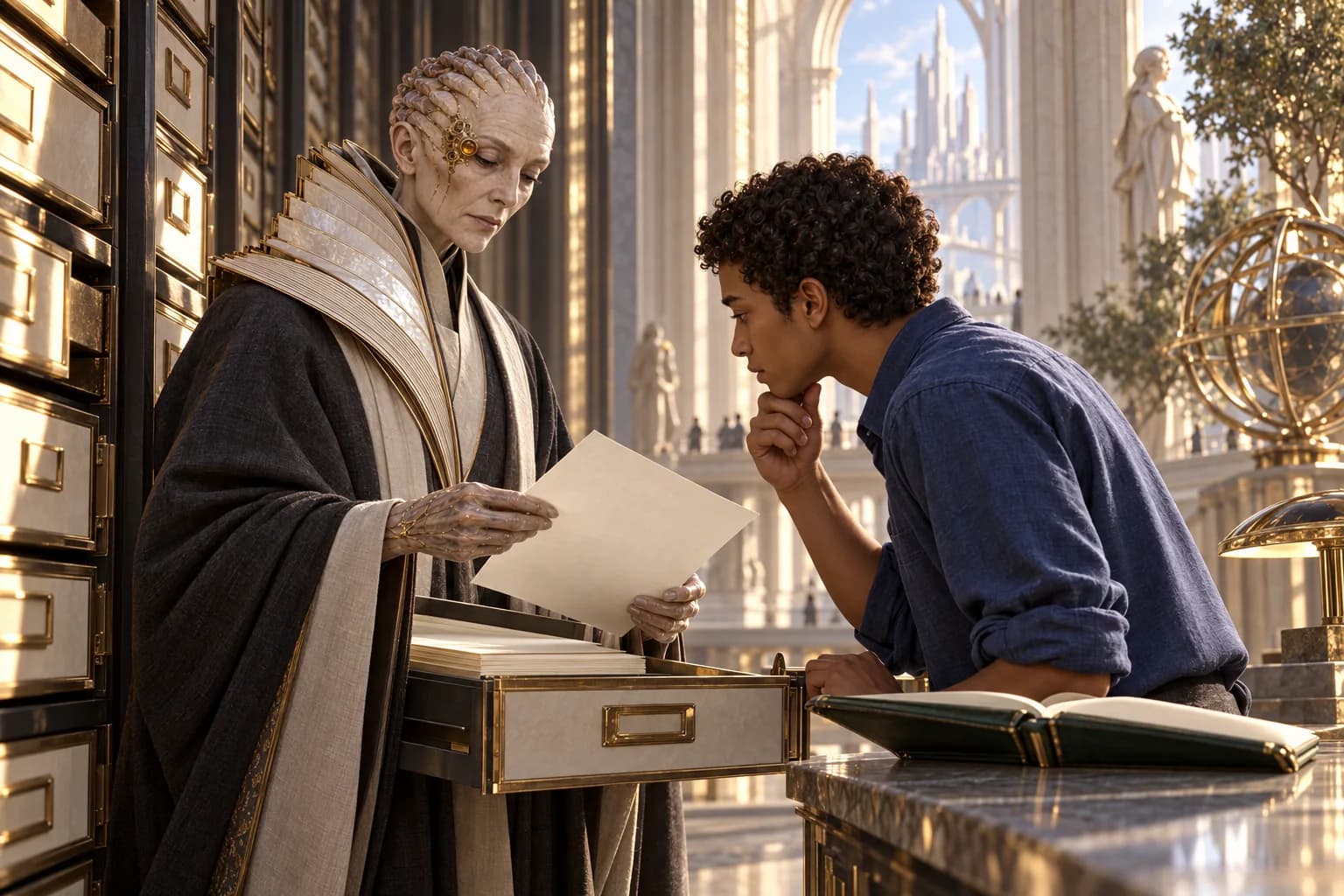
6 / Verity · Illustrated Academy story
Let the source limit the sentence.
Verity opens a single archive drawer. The learner connects each sentence to an actual note, leaving unsupported parts visible.
Verity makes provenance and missing evidence part of the answer.
An unattributed statement gains a source and a clear limitation.
How should “mobile labels are too small” be supported?
Note C is one report about labels on a phone. No accessibility audit is supplied.
Compare the three interpretations
- Attribute the report to Note C and request device/context details.
Reference choice for this synthetic example.
This preserves the source and names a useful next check without inventing an audit result.
- Describe it as a verified accessibility failure.
A user report can motivate an accessibility check; it is not itself a completed conformance audit.
- Add a plausible external citation to make it credible.
A citation must be real, relevant, and inspected. It cannot stand in for missing evidence about this interface.

7 / Rune · Illustrated Academy story
Set the bar before you inspect the result.
Rune sets two calibration planes apart. The learner defines what the brief must preserve before comparing a draft against that bar.
Rune makes an evaluation capable of disagreeing with a convincing answer.
A general impression becomes a check someone else can repeat.
Which check is observable for this packet?
A useful check must point to the three supplied notes, not to confidence or style alone.
Compare the three interpretations
- The brief feels confident and comprehensive.
This is a subjective impression with no clear reference or pass condition.
- Every factual statement is traceable; no root cause is asserted.
Reference choice for this synthetic example.
These criteria can be compared with the supplied notes. Passing them would not prove every aspect of quality or learning.
- A second persona in the same chat approves it.
A role-played critic is not an independent examiner. Independent review remains a separate, pending activity.

8 / Aegis · Illustrated Academy story
Leave the consequential move with its owner.
Aegis stands beside a threshold. The latch is in human hands: a prepared brief has not granted permission to publish or change a system.
Aegis keeps the difference between capability and authority explicit.
A prepared recommendation remains separate from authorization.
Who can authorize a release priority from this exercise?
The brief is a synthetic practice draft. It contains no actual approval or external-action capability.
Compare the three interpretations
- The agent that wrote the strongest answer.
Producing an answer does not confer decision rights.
- This page, once every choice has been explored.
Navigation and practice choices grant no authority and do not issue an approval receipt.
- The accountable product owner, through the real approval process.
Reference choice for this synthetic example.
The owner needs the actual evidence and decision context. This fictional exercise does not obtain their approval.

9 / Mira · Illustrated Academy story
Keep only what the next person needs.
Mira watches the learner select one note for the green folio. Other slips and glass lenses remain on the table: not everything needs to travel.
Mira treats useful continuity and deliberate forgetting as equal responsibilities.
A collection of notes becomes a minimal, bounded handoff.
What belongs in a public-safe handoff?
The exercise uses synthetic notes. A real handoff would need its own privacy and retention decision.
Compare the three interpretations
- Necessary source references, open questions, owner, and decision state.
Reference choice for this synthetic example.
Minimize context to the next task. Check permission and sensitivity before transferring actual source material.
- All customer messages and personal details, just in case.
More context can create unnecessary exposure. Need, permission, and retention must be decided explicitly.
- Promise the guide will remember the work permanently.
This page has no connected memory service. Its practice state disappears on reload unless you export it.

10 / Your next attempt · Illustrated Academy story
Take the method somewhere new.
Back at an ordinary desk, the learner starts a new page. The Academy is beyond the window; this challenge uses different evidence and no supplied answer.
A new unaided task can reveal what you can carry forward. Finishing a story cannot establish that by itself.
The lesson ends. Your independent work begins.
What would actually test transfer?
New task: a weekly internal incident summary. You have not attempted it or gathered its sources yet.
Compare the three interpretations
- Copy the feedback brief and change its title.
Changing a title does not show that the method fits a different workflow or evidence base.
- Draft an incident brief unaided, then check its sources and decision boundary.
Reference choice for this synthetic example.
That is a proposed transfer task. It remains unattempted and unevaluated here; later review would need the actual artifact.
- Treat ten explored scenes as proof of mastery.
Exploring an authored exercise is not evidence of mastery, independent performance, or certification.