Trace the energy before admiring the machine
Fusion joins light nuclei and can release energy. Stars and laboratory fusion systems operate under very different conditions. A striking reactor image does not tell you whether a device supplies useful net electricity. Distinguish an experiment, a power-producing process and a complete energy system.
Draw a boundary around the system you are evaluating. Include energy entering, useful output, waste heat, materials, maintenance and the equipment needed to operate it. Changing the boundary can change what an impressive efficiency or gain claim actually measures. Ask which inputs were counted.
Sustainability is a relationship to measure
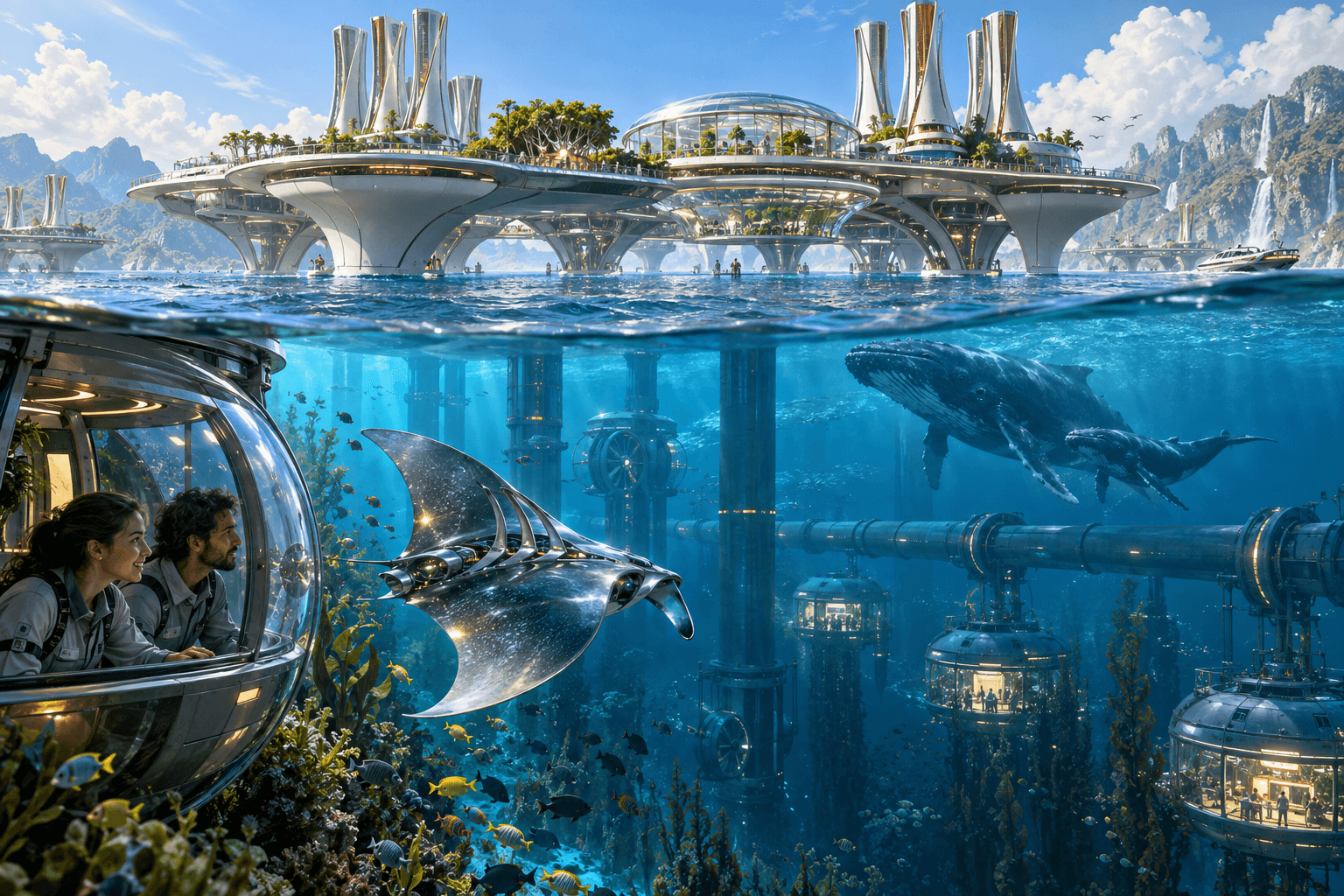
A green roof or a whale beside a machine is a visual idea, not evidence of ecological benefit. In the imagined ocean campus, the important questions include habitat disruption, water quality, noise, migration access and the materials needed over the installation's life.
Choose a measurable question and a comparison. For example: does a proposed corridor preserve an observed migration route relative to a defined baseline? Name who gathers the evidence, over what period and under which conditions. A system may improve one outcome while worsening another. Keep the trade-off visible.
Evolution is not a ladder toward our design
Natural selection involves variation, inheritance and differences in reproductive success in particular environments. It has no predetermined goal of making life resemble an engineered ideal. A cybernetic animal in this gallery is speculative design, not an example of inevitable biological progress.
Use ecological relationships as constraints on invention. Map which organisms depend on which conditions, then ask how a change could travel through the system. The most interesting future is one whose care can be examined at the level of water, materials, behavior and maintenance.
A worked example · Illustrative
A boundary for a marine campus
System: research campus + local water corridor
Inputs: electricity, materials, maintenance, water
Outputs: research services, heat, waste, disturbance
Ecological question: is migration access preserved?
Baseline: documented route and seasonal conditions
Evidence: observations before and after, with uncertainty
Trade-off: energy benefit does not erase habitat impact
Put the idea to work
Your practice
- Draw the boundary around one imagined Academy installation.
- List material and energy flows, including maintenance.
- Choose an ecological outcome and a meaningful baseline.
- Name one trade-off that the artwork alone cannot resolve.